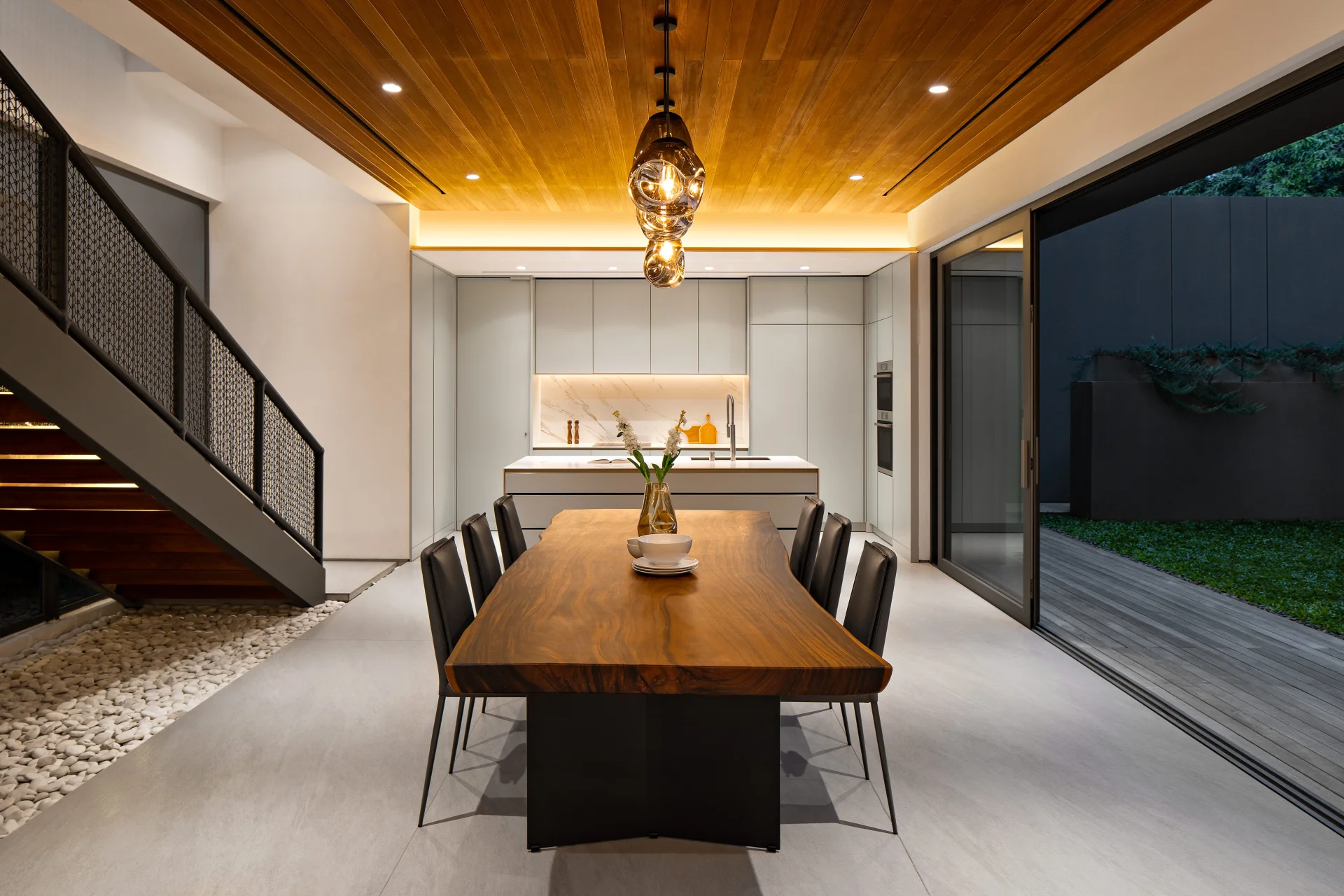
Take a guess.
Here are two photos of luxury homes. Both are neat, both are bright, both are lovely to look at. One was built smoothly, and the other was full of drama along the way.
Which is which? We cannot guess. Neither can you. And that is exactly the problem with a portfolio made only of photos.
One project page can answer what a photo cannot
A photo of the finished result shows what the house looks like. A good project page shows how the house got there.
At least four things can be read from a well-documented project:
Element | What you can read from it |
|---|---|
Scope | What work was handled, and how large it was |
Challenges | What difficulties came up, such as a tight lot or changes midway |
Process | How the work progressed from start to finish |
Result | What the final condition looks like, with details and documentation photos |
That is why a portfolio feels more convincing when each project has its own page: context, details, and a documentation gallery.
Four problems homeowners run into when judging a portfolio
- Seeing only finished-result photos with no context. There is no note on location, type of work, size, or year. We know the house is beautiful, but not what the contractor actually did.
- The process and challenges are invisible. A good photo does not tell the hard parts: how a narrow lot was handled, or how a mid-project change was managed.
- Hard to find projects similar to your needs. A mixed-up gallery of houses, shop-houses, and interiors makes you guess which ones are relevant.
- Hard to confirm the details behind a photo. Without captions, there is nothing to ask about: when it was done, what was handled, and who was responsible.
All four share the same root: the portfolio is read as a display, when it is more useful read as a work record.
Five ways to read a contractor's portfolio more carefully
- Look for projects similar to your needs. Check the building type, scale, and location. A two-story house project is more relevant to you than a shop-house project, however good the photos are.
- Check that each project has its own page. Ideally it lists location, type of work, year, photos, and a summary of the work. If all you find is one big gallery with no captions, treat that as a sign you need to ask more questions.
- Look at process photos, not just the final ones. Photos taken while work was underway, such as the structure before it was covered, show the tidiness of the work in a way finished photos cannot.
- Ask specific questions about one project. For example: what was the biggest challenge, what changed midway, and how did the contractor handle it? A smooth, detailed answer usually suggests the project was truly handled closely.
- Ask for references or a visit, if possible. Ask whether any project can be visited or whether any client is willing to be contacted, with their permission, of course. This is not a sign of suspicion, just a reasonable way to be sure.
If you also want to know how a contractor's work is recorded during a project, read Construction Project Documentation. For broader guidance on shortlisting contractors, there is How to Choose a Luxury Home Contractor in North Jakarta.
For architects and facility managers, a project-by-project portfolio is a reference
For architects who recommend contractors to their clients, a detailed project page makes it easier to judge whether a contractor's experience fits the character of the project being designed.
For organizations or agencies looking for a contractor for an operational building, a project-by-project portfolio helps find the experience closest to their needs, complete with scope and results.
How we present our portfolio at Cabima
We try to present our portfolio project by project, with context, details, and documentation. You can judge for yourself from the work we have handled, and ask us directly about the project closest to what you need.
Once a project is underway, we send a progress report every two weeks, help arrange permits such as the PBG (Persetujuan Bangunan Gedung, the building approval permit), prepare an itemized RAB (Rencana Anggaran Biaya, the detailed cost budget) from the start, and offer a 3-month workmanship (finishing) warranty and a 1-year leak warranty.
Frequently asked questions
- What is a project-by-project portfolio? A project-by-project portfolio presents a contractor's work on a separate page for each project, with context, work details, and a documentation gallery.
- Why aren't finished-result photos enough? Photos of the result show appearance, but not the scope, challenges, and process behind it. Hidden parts such as structure and installations only show up through process documentation.
- What should a project page include? Location, type of work, year, photos or a documentation gallery, and a work summary covering scope, challenges, process, and results.
- Is it important to choose similar projects? Yes. Experience on projects similar to your needs is more relevant than the total number of projects.
- May I ask to see a project in person? You may ask. Visits or client references depend on the project owner's permission, so they cannot always be arranged.
- How can I discuss my project with Cabima? Message us on WhatsApp at +62 813-1515-1881, or visit our office at Kompleks Rukan Sunter ICON, Sunter Agung, North Jakarta.