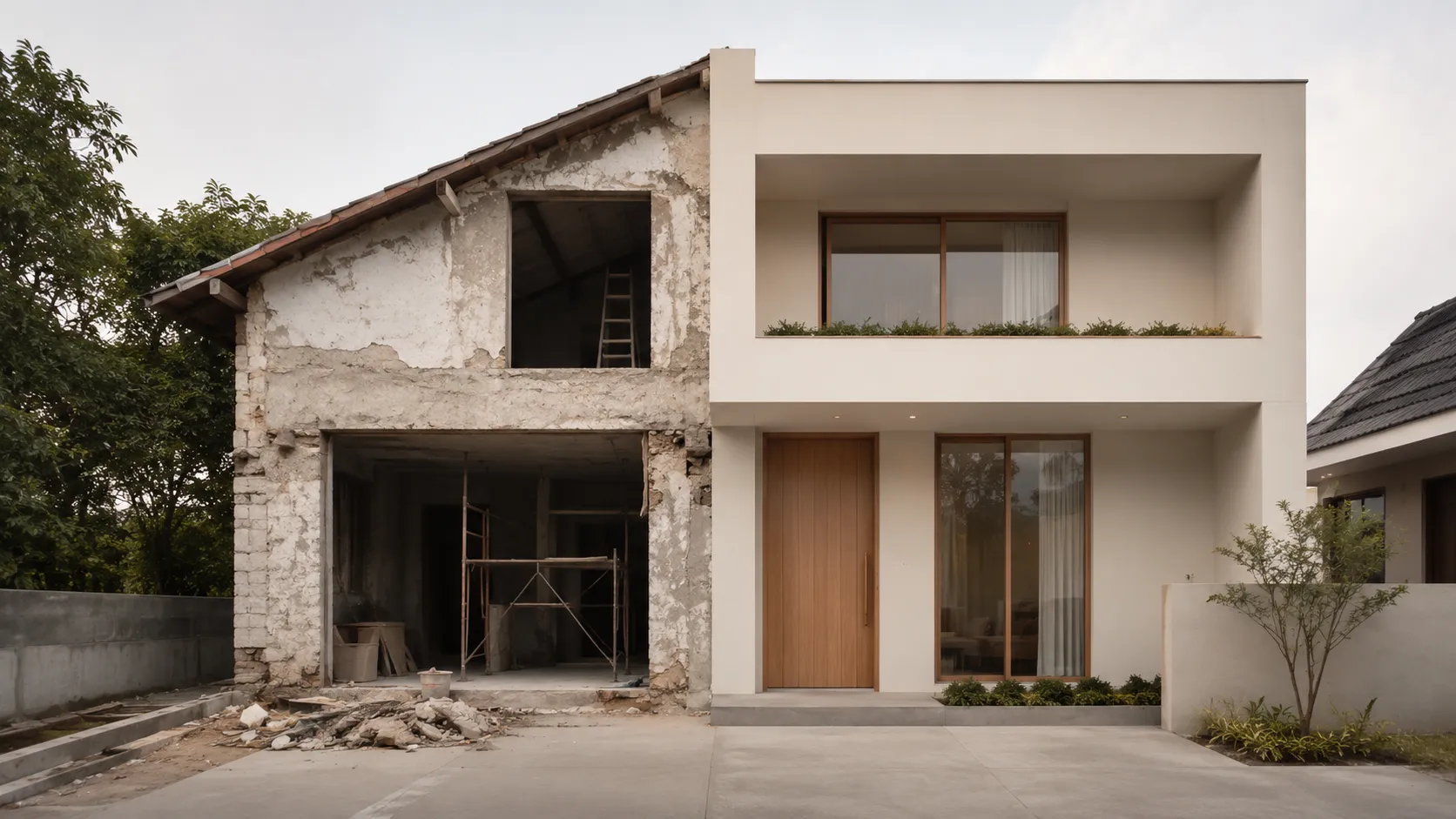
There is something we should admit up front: contractors tend to enjoy building. So if a contractor tells you your house should be torn down completely, it is fair to be a little suspicious. And if another says a fresh coat of paint is all it needs, it is equally fair to wonder whether they have actually checked the structure.
That is the dilemma many homeowners face: two opinions, two price tags, and no easy way to tell which one is right.
This article will not push you toward renovating or building new. We want to help you recognize the problems that tend to come up, and give you tips on what to ask, so you can make the decision calmly.
The question is not "which is cheaper," but "which one won't I regret"
Most people start with cost. That makes sense, but it is not enough.
A renovation that looks economical can turn expensive if the structure turns out to need reinforcement. On the other hand, a new build that sounds costly can feel more peaceful, because you know exactly what is inside the walls.
That is why this decision should rest on data about the building's condition, not on whoever sounds the most convincing.
6 problems homeowners run into most often
- Deciding by appearance, not by structure. Peeling paint makes people want to demolish everything, even when the structure is healthy. The opposite also happens: cracks in a column are dismissed as cosmetic when they may affect the building's strength.
- Surprises behind the walls. Old pipes, brittle wiring, seepage, or termites only show up once the walls are opened. By then the meter is running and it is hard to turn back.
- Assuming renovation is always cheaper. Light renovation is usually more economical. But big changes, such as moving the kitchen, adding a floor, or removing partitions, can bring the cost close to a new build.
- A layout locked in by the old building. You want a spacious family room, but there are columns and structural walls in places that cannot move. The result is a design full of compromises.
- Permits and regulations get missed. Major renovations and new builds can both touch rules such as PBG (Persetujuan Bangunan Gedung, the building approval permit), KDB (Koefisien Dasar Bangunan, the building coverage ratio), and setback lines. If these are checked halfway through, the plan may have to change.
- Time and living arrangements are not counted. Renovating while you live there means dust, noise, and limited space. Building new means your family needs somewhere else to stay. Both carry costs that rarely make it into the first calculation.
All six share the same root: the decision was made before the building's real condition was known.
Quick comparison: when to renovate, when to build new
This table is no substitute for a survey. It is a rough map to help you ask the right questions.
Factor | Renovation usually fits when | Building new usually fits when |
|---|---|---|
Structure | Foundation, columns, and beams are still healthy | There is widespread or recurring structural damage |
Layout and space needs | Changes are mostly cosmetic or a rearrangement | You need a fundamentally different layout |
Cost | The scope of work is limited and clear | Repair costs approach the cost of rebuilding |
Time and housing | Work can be done in phases | You can move out temporarily during construction |
Permits | Changes stay within current regulations | The old building no longer complies with local rules |
Risk of surprises | The building has been surveyed first | You want certainty about materials and quality from day one |
Seven steps before you decide
- Start with a list of needs, not a decision. Write down what is non-negotiable (for example, a ground-floor bedroom for elderly parents) and what is just nice to have. This list determines whether the old building can accommodate them at all.
- Ask for a condition survey first. A condition survey is an inspection of the structure, roof, plumbing and electrical systems, and moisture, done before any figures are quoted. It is the step most often skipped and the one that matters most.
- Ask for two RABs to compare. A RAB (Rencana Anggaran Biaya) is a detailed cost budget. Request one for the renovation scenario and one for the new build, with the same scope of needs, so the comparison is fair.
- Set aside a contingency. A contingency fund covers surprises discovered after demolition begins. How much to reserve is best discussed with your contractor, based on the building's age and condition.
- Check permits and regulations early. Ask about PBG, KDB, and setbacks at your location. Rules differ by area, so confirm through your contractor, a consultant, or the relevant local office.
- Count the time and the temporary housing. Ask how long the work will take, which parts of the house stay usable, and whether your family will need to move out for a while.
- Photograph the original condition before anything is demolished. Dated photos from before, during, and after the work protect you if memories differ later. We cover this in more depth in our article on construction project documentation.
One last tip, and the cheapest one: listen to more than one party. Once a survey and two RABs are on the table, a decision that felt stressful usually becomes much lighter.
For architects and facility managers, the decision has an extra layer
For architects, the existing condition of a building sets how far the design can go. A thorough survey and as-built drawings (final drawings that reflect what was actually built) help keep the design from colliding with the old structure.
For organizations or agencies managing an operational building, there is an added question: do activities need to keep running during the work? If so, phased renovation, or a new build on a separate site, may be the safer choice.
How we help at Cabima
We start by looking at the building's condition and listening to what you need, and only then talk numbers. We put the results into a RAB that is itemized from the beginning, so you can compare scenarios clearly.
We also help arrange permits such as the PBG, send progress reports every two weeks, and offer a 3-month workmanship (finishing) warranty and a 1-year leak warranty.
Frequently asked questions
Is renovating cheaper than building new? There is no single answer. Light renovation is usually more economical, but a major one can approach the cost of a new build. The fairest way to compare is to request a RAB for both scenarios with the same scope.
When should I choose to build new? When structural problems are widespread, the layout you need is very different from the old building, or repair costs are close to the cost of rebuilding.
Does a major renovation need a permit? It can. Changes that touch the structure or the building's floor area generally need to be checked against local rules such as the PBG. Confirm through your contractor, a consultant, or the relevant office in your area.
What is a condition survey? A condition survey is an inspection of an existing building, covering structure, roof, installations, and moisture, to find out what is still worth keeping.
Can a renovation be done in phases? Yes, and it often helps if you want to stay in the house or manage cash flow. The trade-off is that the total duration can be longer and coordination more complex.
Do I have to move out during the project? It depends on the scope. Light renovation often lets you stay, while a new build or major renovation usually requires temporary housing.
How can I discuss my house with Cabima? Contact us on WhatsApp at +62 813-1515-1881, or visit our office at Kompleks Rukan Sunter ICON, Sunter Agung, North Jakarta.