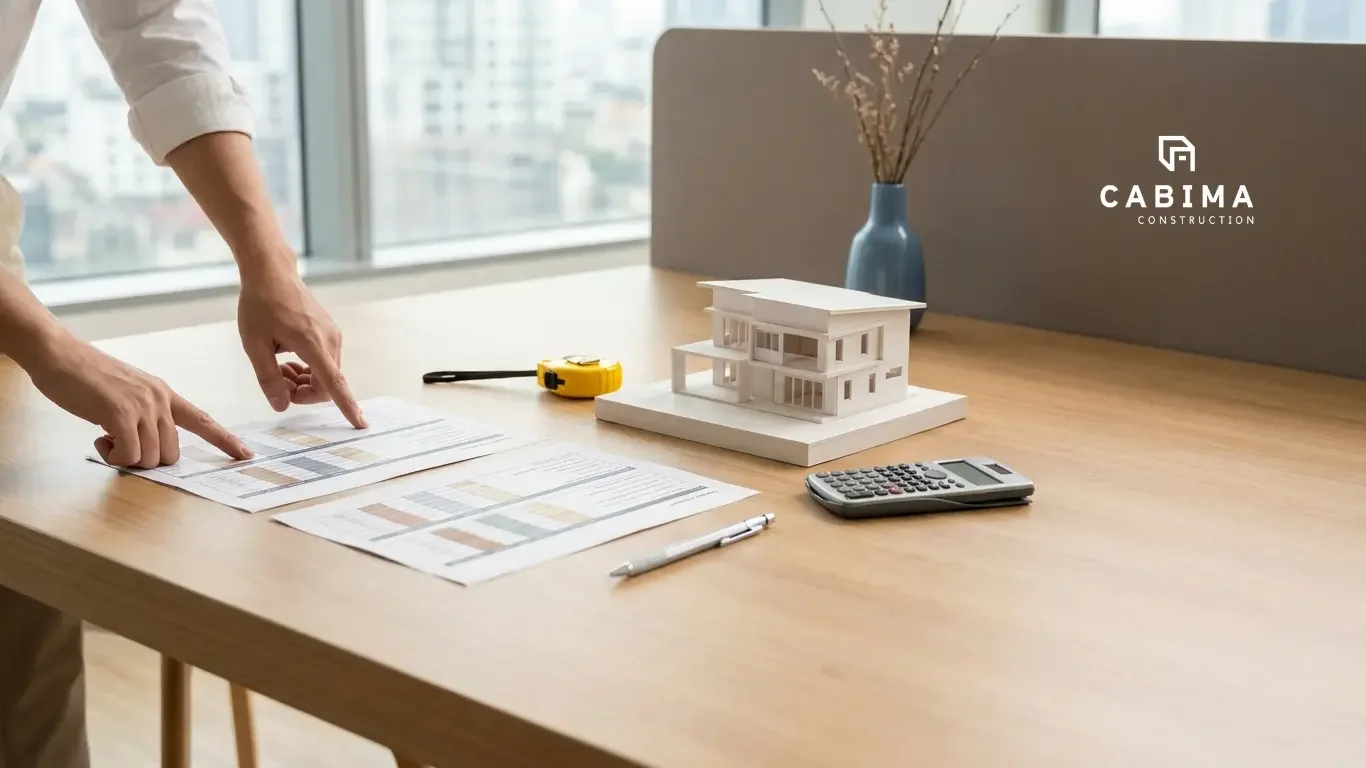
Two printed quotations lay side by side on the dining table. Same house: two storeys, same plot of land. But the price "per square meter" was quite different.
The owner had read both many times. Is the cheaper one really a saving, or has something been left out? Is the expensive one fair, or is it simply too high?
It is normal to feel unsure. The money for a house is usually saved up over a long time, and nobody wants to regret a decision halfway through the project.
The first question people ask is almost always: "What is the building cost per square meter?"
Our honest answer: it depends. We know that answer is annoying. We get frustrated too when we ask for a price and are only told that. So in this article we explain what it depends on, so the number you hold in your hand is not used the wrong way.
Short answer: The building cost per square meter varies because that single number bundles many things: how the area is measured, the number of floors, the structure, materials, finishing, MEP installations (mechanical, electrical, plumbing), soil conditions, and what is included in the quotation. Two per-square-meter prices can only be compared when all of these are the same. A reliable rupiah figure only exists once the drawings and specifications are clear and have been worked into a BoQ (Bill of Quantities and cost estimate, known in Indonesia as RAB).A per-meter figure is a result of division, not the price of one item
The price of a phone is attached to one item with the same specifications in any shop.
A house is not like that. "Per square meter" is a division: total cost divided by built area. The area is easy to calculate. The total cost is made up of dozens of different kinds of work.
A house cost estimate (RAB) usually covers structural work, architectural work, MEP, labor, and miscellaneous work. The size of each part changes with the design and the materials chosen.
One example from research: in a case study of a two-storey house in Bandar Lampung, concrete structural work was around 30% of the total work cost. That is one case, not a general benchmark. It only shows that structure is just one part; the rest is decided by the design and materials you choose.
Seven things that often make a per-meter figure confusing
1. A rough figure is treated as the final price
A number you hear in conversation or read online is usually a rough estimate. It is enough to gauge an early budget, but it is not a quotation.
The problem appears when that number is used to judge a real quotation. A quotation that feels too expensive or too cheap is often just different in scope from the number already fixed in your head.
2. The "meter" is calculated in different ways
Which square meters are we talking about? Land area is different from building area. For multi-storey houses, the area is usually added up across all floors. Carports, terraces, balconies, and roofs are counted in full by some and partially by others because the work is lighter.
Any of these methods is fine, as long as it is clear. The problem is when two quotations use different methods but both are written as "per square meter".
3. The specification has the same name but is a different product
Two quotations both write "ceramic tiles" and "paint". One means small plain tiles, the other large tiles with a special pattern. Paint also comes in several grades.
The same goes for "standard finishing" and "premium finishing". Without a written list of specifications, those two terms are just impressions, not measurements.
4. Some work is not included in the calculation
Many per-meter figures only cover the main building. Items that are often outside the calculation:
- soil investigation and special foundation work,
- permit processing,
- fence, garden, and outdoor areas,
- equipment such as air conditioners, water heaters, or security systems,
- furniture and interior.
Usually this is not because something is being hidden. More often, nobody asked, so nobody wrote it down.
5. Soil and location also matter
Soil and location affect the type of foundation, the amount of fill needed, truck access for materials, and even the working hours allowed in dense neighborhoods.
Soft soil needs a different foundation from hard soil. That is why soil investigation results should be reviewed before the price is locked in, not after the work has started.
6. Numbers from somewhere else are brought into your project
Someone often says, "My relative built a house at this price per square meter." It may be true. But material prices change, costs differ from city to city, and the house is different too.
A figure from a neighbor, an old article, or another city may be right where it came from, but it does not necessarily fit your house today.
7. Changes along the way have no rules
Adding a window, moving the kitchen, or changing the flooring during construction is normal. What is risky is when there is no agreement on who approves the change and how it is priced. Small changes pile up, and at the end the difference feels large.
The per-meter figure felt right at the start, and the final figure feels off. But the figure did not move. The scope changed.
Eight things you can do so the per-meter figure does not mislead you
1. Write down first what you want to build
Before asking for a price, write down your needs: number of floors, bedrooms, bathrooms, special rooms (home office, family room, service area), carport, and so on. One page is enough.
This note makes everyone calculate the same thing.
2. Align how the area is measured
Ask for a breakdown of area per floor and per zone: fully enclosed, semi-open, and open. That way you know exactly which "meter" is being discussed.
3. Measure specifications by example, not by label
Replace the words "standard" and "premium" with real examples: type and size of tiles, paint type, door and window frame model, sanitary ware type. If possible, ask to see samples or finished projects.
4. Ask for an "included and excluded" list
Ask for it in writing, then check item by item: permits, special foundation, MEP, fence, garden, air conditioning, interior. This list is often more useful than the figure itself.
5. Look at soil data before trusting a final figure
If the land does not yet have soil data, ask whether a soil investigation is needed before the price is locked in.
6. Ask for the per-meter figure to be broken down into a BoQ (RAB)
A per-meter figure is enough for an early conversation. For decisions, ask for the breakdown: what work, what volume, what unit price. We have discussed how to read estimate and quotation documents in early estimates before requesting a quotation.
7. Set aside a contingency fund and agree on rules for changes
Leave room for the unexpected. How much is something to discuss with the contractor or architect according to the complexity of the project.
Also agree from the start: changes must be in writing, priced before the work is done, and approved by you. A rule this simple prevents a lot of misunderstanding.
8. Compare on the same terms
After receiving several quotations, put them into one table. A price difference only means something when the other rows are the same.
What to compare
Quotation A
Quotation B
Quotation C
Area counted (per floor and zone)
Main material specifications
What is included
What is excluded
Work schedule
Payment stages
Rules for changes in work
This table does not guarantee you will pick the cheapest. But you will be choosing with the same information.
Luxury homes in North Jakarta: the per-meter figure is even harder to rely on
For houses with a special design, a per-meter figure becomes even less reliable. Long spans, large glass openings, custom-ordered materials, swimming pools, or smart home systems cannot be treated the same as a standard-design house.
This kind of work also often has longer material lead times. The earlier materials are chosen, the less likely the schedule and cost are to change in the middle of the project.
Soil conditions in coastal areas, including parts of North Jakarta, should also be checked early because they affect the foundation.
For developers and institutions: per meter is enough for an early budget, not for a contract
For developers, institutions, or building owners, a per-meter figure is commonly used to set a budget ceiling at the early stage.
But contracts and execution need more detailed documents: working drawings, technical specifications, and a bill of quantities with unit prices. Many regions and institutions also have their own unit price references, so figures cannot simply be carried across regions.
In short: per-meter figures for the early budget, a BoQ (RAB) for decisions.
Frequently asked questions
What is the building cost per square meter right now?
There is no single figure that applies to every house. It depends on location, design, specifications, and scope of work.
How Cabima uses per-meter figures
Cabima is a general contractor in North Jakarta that handles building construction, renovation, interior fit-out, and project documentation. That is why we see a per-meter figure as a starting point for conversation, not a final price.
Is the per-meter cost of a one-storey house the same as a two-storey house?
Not necessarily. Multi-storey houses need different structure, foundations, and stairs, so the cost per square meter may not be the same. Compare them through a BoQ, not an average figure.
Does the per-meter cost include design and permits?
Not automatically. Ask directly, and have the answer written in the "included and excluded" list.
Why can two contractors give very different figures for the same house?
The most common reasons: scope of work, material specifications, how the area is measured, and assumptions about soil conditions are not the same. Align these four first before deciding who is more expensive.
Can I calculate the cost of a house myself by multiplying the area by the price per meter?
Yes, for a rough idea. For decisions, use a BoQ prepared from your project's drawings and specifications.
If you already have an idea of the area and the rooms you need, send it via Cabima's WhatsApp at +62 813-1515-1881