"Hi, roughly how much would it cost to build a two-story house?"
It is a perfectly natural message to send. But it is almost impossible to answer with a number you can rely on.
That is not because contractors want to dodge the question. Asking for a price without explaining what you need is like asking for the total on a restaurant bill before ordering any food. The waiter would ask right back: what would you like to eat, and for how many people?
A project brief is the answer to that follow-up question, written down in advance so you do not have to keep explaining yourself.
A brief is a statement of needs, not a contract
Many people assume a brief has to be complicated, complete with technical drawings. It does not. A brief is simply a note about what you want and the limits you are working within, one or two pages is enough.
Its job is simple: help the contractor understand what you need, so the estimate they prepare is more relevant. A brief does not legally bind you, and you can update it as the conversation moves along.
Six problems homeowners run into most often
- Asking for a price with no context. A question like "how much per square meter?" sounds practical, but the price per square meter can vary widely with materials, design, and site conditions. The numbers are hard to compare apples to apples.
- Struggling to put wishes into words. "Minimalist but warm" means different things to different people. Without examples, a contractor can only guess.
- Being afraid to mention the budget. Many people worry that the number they give will become a ceiling. The quotes that come back end up far from reality, and everyone wastes time.
- Not describing the starting condition. Empty lot or an existing building? Is access wide or narrow? Are drawings already available? These things affect the work, but they often surface only midway through.
- Unclear timeline. "As soon as possible" is not a schedule. Without a deadline and the reason behind it, a contractor cannot sequence the work sensibly.
- Every contractor gets different information. You explain things one way to contractor A and another way to contractor B. The quotes cannot be compared, and you end up confused about whom to choose.
All six share the same root: the information a contractor needs has not been written down neatly in one place.
The six elements your brief needs
No technical language is required. Just answer these six questions honestly and as clearly as you can:
Element | What to write | Example |
|---|---|---|
Location | Address or pin location, and access to the site | "Sunter, North Jakarta; the access road fits about two cars" |
Starting condition | The current state of the lot or building | "An old single-story house, partly to be demolished" |
Scope of work | What work is requested | "Build two floors, including a garden and carport" |
Visual references | Photos or examples of styles you like | A few photos of houses you like, with notes on what appeals to you |
Target timeline | When you want to start and finish, and why | "We want to move in before the children start the new school year" |
Budget range | A range of costs you are comfortable with | "Somewhere between X and Y, furniture not included" |
The examples above only show how to write each item. Adapt them to your own project.
Seven tips for writing a brief without the headache
- Start from daily life, not from drawings. Write down who will live there, how many people, and daily habits. For instance, parents who need a ground-floor bedroom, or a kitchen that is often used for big cooking. This makes it easier to translate your needs into space.
- Collect visual references, then add notes. Photos alone are not enough. Mark what you like, such as "the lighting, not the color of the sofa." These small notes prevent a lot of misunderstandings.
- Separate must-haves from nice-to-haves. Distinguish must-haves (non-negotiable) from nice-to-haves (good if possible). If the budget is tight, this list decides what gets cut first.
- Be honest about your budget range. A range is enough, not an exact figure. Also say whether it includes interiors, furniture, and permits, so the quote does not miss the mark.
- Attach photos and site data. A location pin, photos of the current condition from several angles, the lot size if known, and any land or building documents you have. The more complete it is, the less guesswork.
- Give a target timeline and the reason for it. "Finished before a family event" is more useful than "as soon as possible." Also say whether the schedule is flexible.
- Send the same brief to every contractor, then compare. With the same information as a base, quotes can be compared through the RAB (Rencana Anggaran Biaya), the itemized breakdown of costs, not just the final number. For help choosing a contractor, also read How to Choose a Luxury Home Contractor in North Jakarta.
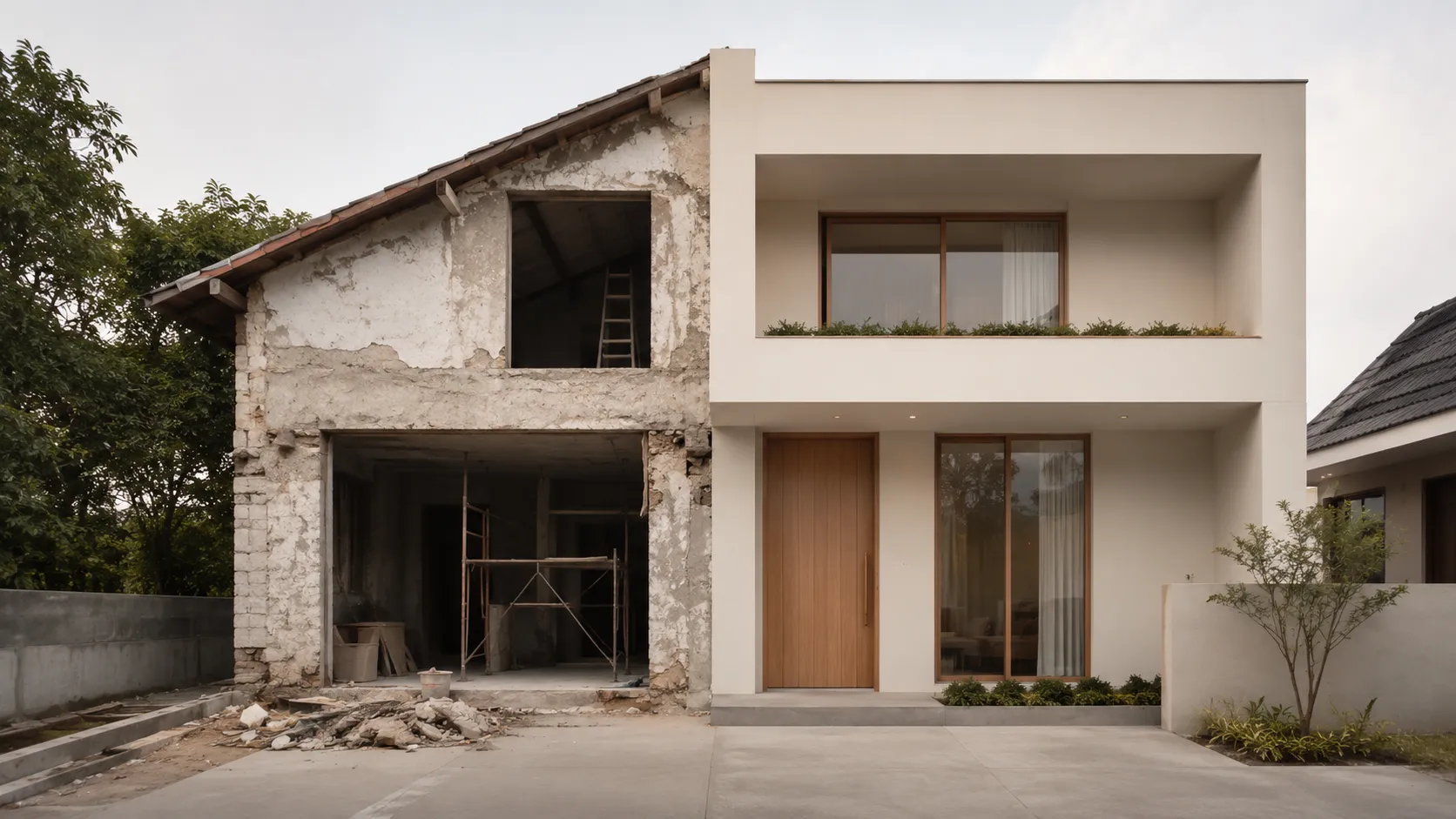
A brief does not have to be perfect on the first try. Start with what you know, flag what is uncertain, and update it as discussions go on. If you are still weighing whether to fix up the old house or rebuild, this article can help you decide before you write the brief.
A one-page brief template you can copy right away
Copy this outline and fill in what you can:
- Location: [address / pin location, access conditions]
- Starting condition: [empty lot / existing building, size if known, documents you have]
- Scope of work: [new build / renovation, number of floors, rooms needed]
- Must-haves: [things that are non-negotiable]
- Nice-to-haves: [things that would be good to have]
- Visual references: [links or photos, with notes on what you like]
- Target timeline: [start and finish, the reason, flexible or not]
- Budget range: [a range, and what it includes]
For architects and facility managers, a brief is also a shared language
For architects, a written brief helps the client and the contractor start from the same understanding, so plans, specifications, and quotes connect more easily.
For organizations or agencies building an operational facility, the brief usually needs to add operational requirements, budget limits, and a schedule tied to internal processes. The more detailed those notes are, the easier it is to prepare and justify a quote.
How we read your brief at Cabima
We start from the brief, then ask about anything unclear before talking numbers. We put the result into an itemized RAB from the start, so you can see where each figure comes from.
Once the project is underway, we send a progress report every two weeks, help arrange permits such as the building approval permit, and offer a 3-month workmanship (finishing) warranty and a 1-year leak warranty.
Frequently asked questions
What is a construction project brief? A construction project brief is a short note of your needs, written before requesting a quote. It covers location, starting condition, scope of work, visual references, target timeline, and budget range.
Do I need design drawings before requesting a quote? No. A brief can start from needs and visual references. Design drawings can follow with an architect or the contractor's team.
Do I have to state my budget? It is best to, as a range. A range helps the contractor adjust materials and scope so the quote is realistic.
How long should a brief be? One or two pages are enough to get started. What matters is that it is clear, not long.
What is the difference between a brief and a RAB? The brief holds your needs. The RAB (Rencana Anggaran Biaya) is the itemized cost breakdown the contractor prepares based on that brief.
What if my needs change after I send the brief? Tell the contractor as soon as possible and write down the change. Changes made early are much easier to handle than changes made midway through the work.
How do I send a brief to Cabima? Send it via WhatsApp at +62 813-1515-1881, or visit our office at Kompleks Rukan Sunter ICON, Sunter Agung, North Jakarta.